Who wouldn’t want to be happy, healthy, and well-adjusted? Everyone is looking for emotional balance in an unpredictable world, and life often throws curveballs that can lead to stress, anxiety, and other mental health challenges.
To keep your head above water, you need coping mechanisms that help you face challenges effectively. That’s where psychological flexibility comes in.
In this guide, we’ll unpack what psychological flexibility is, share exercises you can try today, and explain how we put this model to work in residential care at Red Top Wellness Center.
What Is Psychological Flexibility?
Psychological flexibility is the ability to stay present with difficult thoughts and feelings, without letting them dictate your behavior, so you can act in ways that move you toward what matters to you. Rather than eliminating painful emotions, psychological flexibility helps you change your relationship to them.
This process involves:
- Being able to accept what you cannot change
- Living in the present moment instead of the past or the future
- Taking action in line with your values, even when it’s uncomfortable
How Psychological Flexibility Is Built
Acceptance and Commitment Therapy (ACT) is a therapeutic framework designed to build psychological flexibility by encouraging you to accept your inner thoughts and feelings rather than fight them. ACT works by loosening the grip that difficult internal experiences have on your behavior, and it’s one of the most effective ways to build psychological flexibility in structured treatment.
Rather than trying to eliminate or argue with painful thoughts and feelings, ACT teaches you to change how you relate to those experiences so they stop dictating your behavior. This process can be especially helpful for treating:
- Depression
- Post-traumatic stress disorder (PTSD)
- Obsessive-compulsive disorder (OCD)
- Anxiety
Why Is Psychological Flexibility Important for Mental Health?
Research shows that psychological flexibility is a fundamental aspect of mental health, impacting one’s ability to:
- Accept challenging circumstances
- Regulate emotions
- Practice mindfulness
- Choose behaviors that lead to the best outcome in a situation
In essence, these abilities are the foundation of mental health. Psychological flexibility promotes wellness and improves your ability to handle life’s challenges.
People with greater psychological flexibility often report lower rates of depression, anxiety, and general psychological distress. They also enjoy a better quality of life because they spend less energy fighting their internal experiences and more energy engaged in living.
This is why psychological flexibility has become a key area of clinical research that goes beyond any single diagnosis. Instead of treating each disorder as a separate set of symptoms, clinicians following this approach look for the same underlying pattern: avoidance, fusion, and disconnection from values. Strengthening flexibility at this deeper level tends to improve overall functioning, not just in the area that originally brought someone into treatment.
The 6 Core Processes of Psychological Flexibility
Psychological flexibility is built from six interconnected processes, and strengthening any one process tends to strengthen the others.
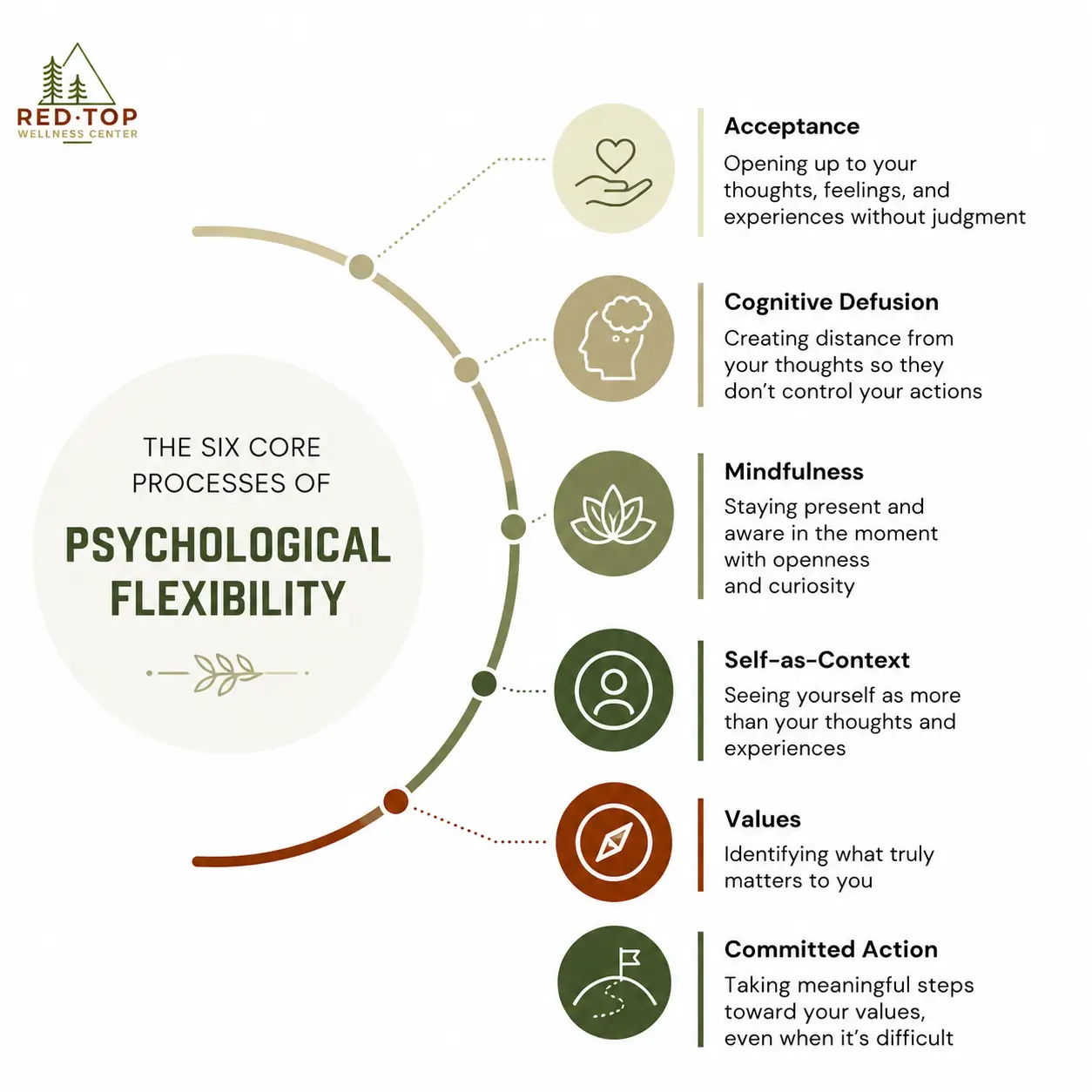
1. Acceptance
Acceptance means acknowledging and making room for what’s happening in the present moment, rather than fighting it. Instead of developing avoidance behaviors or denying a situation is happening, acceptance means allowing difficult emotions to be present without struggling against them. This reduces emotional reactivity and increases cognitive flexibility, which is particularly useful when dealing with distressing situations that are outside your control.
To practice acceptance: Next time you notice anxiety, sadness, or anger rising, pause and identify it. Then, take three slow breaths and let the feeling exist without trying to push it away or fix it. Notice that you can carry the feeling and still choose your next action.
2. Cognitive Defusion
Cognitive defusion is the ability to step back from unhelpful thoughts rather than getting tangled up in them. It involves observing a thought as just a thought, which makes it easier to see situations from different angles. Defusion techniques are especially effective for negative automatic thoughts and self-criticism.
To practice cognitive defusion: Take a harsh self-judgment like “I’m a failure” and add the phrase “I’m having the thought that…” in front of it. For example, “I’m having the thought that I’m a failure.” Repeat it a few times, or say it slowly in a silly voice. The thought won’t disappear, but its grip loosens.
3. Mindfulness (Being Present)
Mindfulness involves paying attention to the present moment without judgment or distraction. It interrupts rumination about the past and worries about the future, so you can become more in tune with your thoughts, emotions. Mindfulness has been shown to reduce stress, anxiety, and depression symptoms while increasing overall wellbeing.
To practice mindfulness: Take a seat in a place that feels comfortable and set a timer for five minutes. Focus on your breathing, observing the natural rhythm of your body as you breathe in and out slowly. Notice your entire body and how you’re feeling physically.
If you want to practice mindfulness in an environment where you can’t step away for some peace and quiet, lean into your surroundings by being present in the moment.
4. Self-as-Context
Self-as-context is the recognition that your thoughts, feelings, and experiences are temporary and don’t define the core of who you are. Sometimes described as the “observing self,” this process helps you understand that you are the constant space in which experiences come and go. This understanding builds resilience and flexibility in response to difficult situations.
To practice self-as-context: Recall a strong emotion you felt years ago, such as nervousness before a big task, grief after a loss, or embarrassment from a mistake. Focus on the fact that you’re still here even though that feeling has long since passed, and remind yourself that the same is true of what you’re feeling today.
5. Values
Values are the personal principles that guide your behavior and actions. Clarifying your values helps you identify what truly matters so you can use it to guide your daily choices.
Values have consistently been linked to increased wellbeing, happiness, and life satisfaction. In fact, one study found that people who frequently align their actions with their values are more likely to be thriving than those who do not.
To practice your values: Pick one life domain, such as your relationships, health, work, or personal growth. Write one sentence describing the kind of person you want to be in that domain. Then identify one small action this week that moves you in that direction, regardless of how you feel about it.
6. Committed Action
Committed action means taking consistent steps toward your values, even in the face of obstacles, discomfort, or setbacks. It involves setting achievable goals, building a plan, and persisting when things don’t go smoothly. Committed action builds a sense of self-efficacy that reinforces every other process in the psychological flexibility model.
To practice committed action: Break a values-based goal into one concrete action you can complete in the next 24 hours. Do it even if your motivation or mood isn’t cooperating. After all, committed action is defined by what you do, not how you feel while doing it.
ACT in Residential Care at Red Top Wellness Center
At Red Top Wellness Center, we know the importance of developing psychological flexibility and provide evidence-based therapies to help you build it. We incorporate Acceptance and Commitment Therapy (ACT) into our treatment plans when appropriate, and every aspect of our program is designed to support this therapeutic framework.
Residential Care
Our facility in Cartersville, Georgia, provides a comfortable environment where you can fully relax and focus on the healing process. Residential care immerses you in the treatment experience, which is something a weekly outpatient session can’t do. Instead of simply showing up to talk about a triggering thought in a weekly therapy session, you’ll practice noticing and diffusing the thought the moment it shows up, with the full support of our clinical staff.
Individual Therapy
ACT can be applied in one-on-one sessions with your primary therapist, during which you’ll:
- Identify the avoidance patterns that have been driving your symptoms
- Practice defusion and acceptance skills on the thoughts and memories that are hardest to sit with
- Connect daily choices back to your personal values
Group Sessions
In group therapy, you can practice the core processes of ACT with peers who are facing similar challenges and who have walked alongside you throughout your treatment so far. During these sessions, you’ll:
- Learn to define what a meaningful life actually looks like for you
- Separate from the expectations of family, past relationships, or the disorder itself
- Set committed-action goals that you can be held accountable for
Daily Mindfulness Practices
ACT skills are meant to be practiced, not just discussed. Rather than a single lecture on mindfulness, we build it into the structure of your daily schedule in residential care.
This might include grounding practices, check-ins from our staff, and experiential exercises. Recreational therapies, like art and yoga therapy, also provide outlets for you to practice mindfulness in your free time.
Integrated Care
Because psychological flexibility touches nearly every diagnosis we treat, ACT integrates naturally alongside other approaches in our program, including CBT and DBT. That way, you’ll leave with more than one way of relating to a difficult thought or feeling.
ACT is woven into the daily rhythm of residential treatment. Because residential treatment means you’re surrounded by around the clock care, we have the opportunity to work these six processes into real time.
We believe mental wellness is an essential part of overall health, and we’re committed to walking alongside you in every stage of your journey toward healing. That’s why we offer tailored treatment options and a multi-disciplinary approach suited to each unique situation.
If you or a loved one needs mental health care, don’t hesitate to contact us online or call today at (470) 227-7574.