When you’re researching mental health treatment options for yourself or a loved one, a lot of the terminology may seem foreign. For example, what is holistic therapy? Which therapies, such as CBT and DBT, will be used to treat your symptoms? More importantly, what are the differences between inpatient vs. outpatient treatment?
You don’t have to have it all figured out before you commit to a treatment program, but understanding the different levels of care is important for choosing the program that’s right for you. Comparing inpatient vs. outpatient care can help you understand what to expect from a treatment program and how to find the support you need.
Both options are legitimate paths to recovery. The right one depends on your symptoms, your daily responsibilities, and the type of intervention you need to make progress. This guide breaks down inpatient vs. outpatient mental health treatment and how to evaluate which route makes the most sense for you.
What is Inpatient vs. Outpatient Mental Health Treatment, Definitionally?
At the most basic level, the difference between inpatient and outpatient treatment is where you live during care. Inpatient treatment means staying at a treatment facility around the clock for the duration of your care. Outpatient treatment means living at home and attending scheduled sessions.
That distinction shapes almost everything else about your treatment experience, such as the availability of clinical support and how your daily routine impacts treatment. Let’s take a closer look at each level of care.
What is Inpatient Treatment?
Inpatient treatment, also called residential treatment, is a live-in level of mental health care in which you live at the treatment facility for the duration of your care. This level of care is built for people who need consistent structure, close monitoring, or separation from stressors that make recovery difficult at home.
A typical stay includes:
- Comfortable accommodations: You’ll stay in a private or shared bedroom on-site during treatment, which typically lasts a few weeks.
- Catered meals: The facility provides all meals, snacks, and beverages; you don’t have to bring your own.
- A balanced daily schedule: You’ll participate in various types of therapies, including individual and group sessions, throughout each day. You’ll also have time for recreational activities, like outdoor games, and rest.
- Personalized attention: You’ll be matched with a primary therapist, who leads one-on-one meetings with you and monitors your progress during your stay. You’ll also have 24/7 support from a clinical staff for any symptoms that flare up outside of scheduled sessions.
- Medication management: If necessary to treat your symptoms, the staff at an inpatient mental health treatment facility can prescribe and administer relevant medications.
Benefits of Inpatient Care
Inpatient treatment completely immerses you in the treatment environment. During your stay, you’re removed from the stressors of daily life that fuel your symptoms. That means you don’t have to balance work, school, or other stressful obligations while focusing on treatment.
It also provides constant support from trained clinical staff. Instead of having to wait until your next therapy appointment to talk through the thoughts and feelings that come up, you’ll have someone to talk to the moment it happens.
When it comes to treating behavioral health, inpatient care can be especially effective because its structure is better suited to support holistic wellness. In other words, residential programs can help you understand your own behaviors and build new habits along with addressing your thoughts and emotions, because you’re living in the treatment environment 24/7.
Examples of Inpatient Care
Inpatient care is typically offered by:
- Residential or inpatient mental health facilities: Extended stays, often several weeks, focused on conditions like depression, anxiety, PTSD, bipolar disorder, or co-occurring disorders
- Psychiatric hospitals: Short-term, often crisis-driven stays focused on safety and stabilization
- Dual diagnosis treatment centers: Inpatient treatment that addresses a mental health condition and a substance use disorder occurring at the same time, which affects 34.5% of adults in the U.S.
What is Outpatient Treatment?
Outpatient treatment is a program in which you attend recurring therapy or treatment sessions while continuing to live at home. This flexibility can be an advantage for some people and a limitation for others, depending on how much support they’re looking for in a treatment environment.
Outpatient care typically involves:
- Flexible levels of participation, ranging from once-a-week sessions to structured programs that meet every weekday for several hours each day
- Transition support that helps you gradually reintegrate into daily life by slowly requiring less frequent meetings
- An alumni program that keeps you connected to others in recovery, even after you stop scheduling therapy sessions
Benefits of Outpatient Care
Outpatient treatment is best for people whose symptoms are manageable day-to-day and who have a stable home environment to return to. It also works well as the next step down after inpatient treatment, helping you maintain the progress you’ve made once you leave a residential setting.
However, outpatient care is most beneficial when someone sticks with treatment from start to finish. The ability to return home each day makes it easy to “drop out” of outpatient treatment, or stop showing up for appointments before any real progress is made. Research estimates that 20% of patients leave outpatient care after just one session, and that rate increases with the number of appointments.
Examples of Outpatient Care
If you’re looking for outpatient treatment, there are several programs that may benefit you:
- Traditional outpatient therapy: Weekly or biweekly individual sessions with a therapist, which is often the right fit for milder or well-managed symptoms (i.e., every Monday at 9 a.m.)
- Intensive outpatient programs (IOP): Several hours of group and individual treatment, multiple days per week (i.e., Monday, Wednesday, and Friday from 9 a.m. to 12 p.m.)
- Partial hospitalization programs (PHP): A full day of structured treatment, several days a week (i.e., Monday through Friday from 9 a.m. to 3 p.m.)
What Mental Health Conditions Are Treated in Inpatient vs. Outpatient Care?
Each level of care can bring unique benefits to the same diagnosis. For example, both outpatient and residential care for anxiety can teach you coping skills that mitigate symptoms in daily life. What determines the right level of care isn’t the condition itself, but its severity and impact on your ability to function in everyday activities.
Conditions more likely to require inpatient care include:
- Severe depression, especially when it comes with safety concerns or an inability to manage daily responsibilities
- Bipolar disorder during an acute manic or depressive episode
- PTSD with symptoms severe enough to disrupt sleep, work, or relationships on an ongoing basis
- Schizophrenia or schizoaffective disorder, particularly during periods that require closer monitoring and medication management
Conditions often manageable with outpatient care include:
- Mild to moderate anxiety that responds to regular therapy sessions
- Depression that’s present but not interfering significantly with daily life
- PTSD with symptoms that are stable enough to work through gradually
- Bipolar disorder in a maintenance phase, once mood episodes are stabilized
Costs of Inpatient vs. Outpatient Care
Cost is a concerning consideration for many people researching mental health treatment options, especially considering that 9.6% of U.S. adults experiencing a mental illness have no insurance coverage. The truth is, cost can vary widely for both inpatient and outpatient mental health treatment, depending on a few factors:
- Your mental health insurance coverage: The provider, the specific plan, or a lack of coverage at all greatly influence the patient’s financial responsibility.
- The type of treatment you need: While most inpatient programs tend to charge a straightforward price for their program, outpatient programs can be slightly more flexible, especially if you’re paying by appointment.
- Where you receive treatment: Some treatment programs offer nicer facilities and more amenities, causing their costs to be slightly higher.
Generally speaking, inpatient treatment typically costs more per day than outpatient care because it includes housing, meals, and round-the-clock staffing in addition to clinical services. Outpatient treatment can be less expensive per session, but the total cost depends on how many sessions you attend and for how long. Keep in mind that some outpatient programs run for months.
That said, cost alone doesn’t tell the full story. A person who needs inpatient care but only receives outpatient support may end up cycling through crisis visits, missed work, or repeated treatment attempts, which carries its own financial and personal cost over time. Matching the level of care to the severity of the condition often turns out to be the more cost-effective path, even if the sticker price looks higher upfront.
Many insurance plans cover both levels of care, though coverage details vary by provider, plan, and the specific type of treatment. Many treatment programs will verify your insurance benefits for you, so you don’t have to call your insurance provider and try to figure out what’s covered.
6 Main Differences Between Inpatient and Outpatient Treatment
To sum up the difference between inpatient and outpatient care, let’s take a look at them side-by-side:
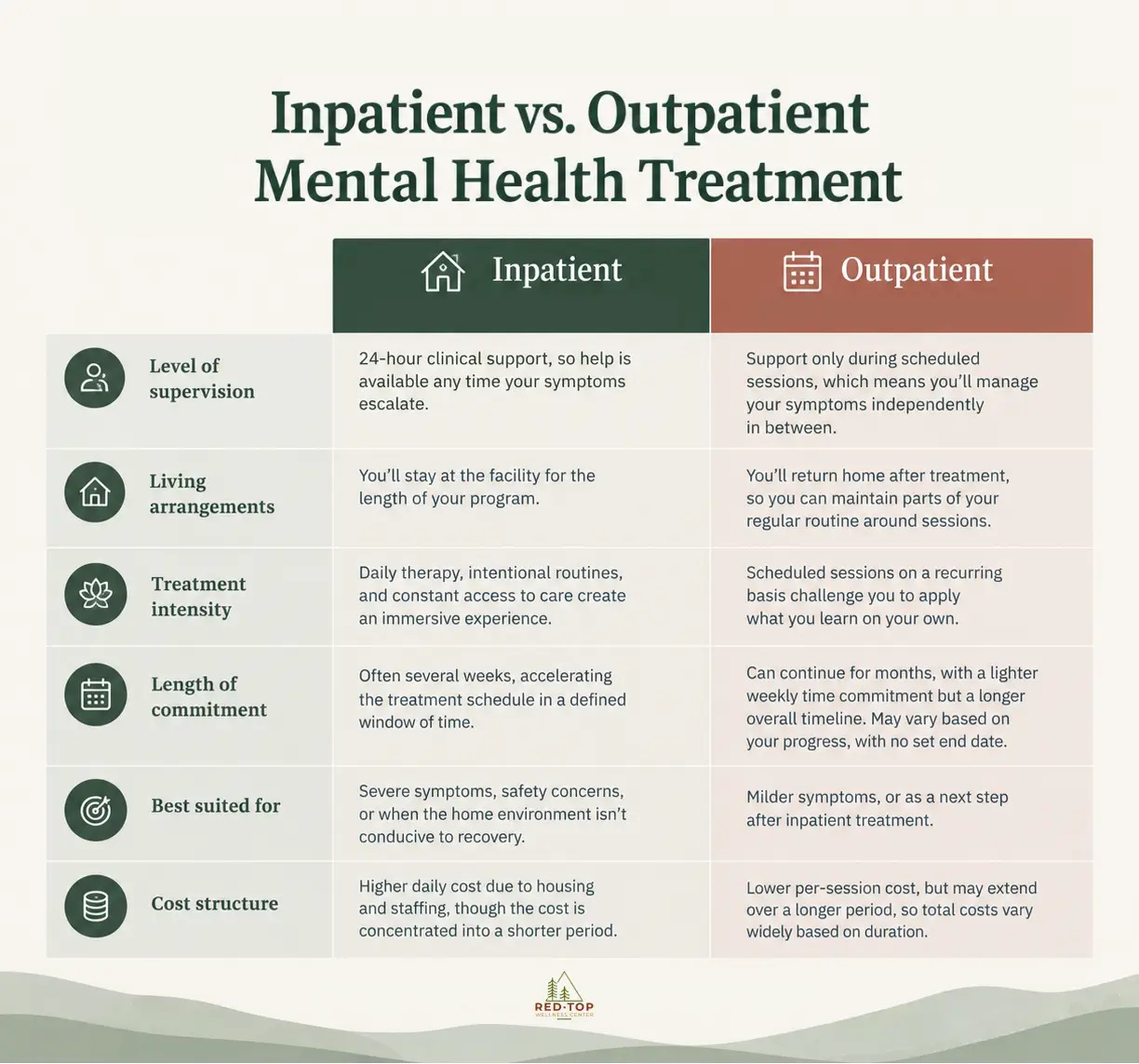
- Level of supervision. Inpatient care provides 24-hour clinical support, so help is available any time your symptoms escalate. Outpatient care provides support only during scheduled sessions, which means you’ll manage your symptoms independently in between.
- Living arrangements. Inpatient treatment houses you at the facility for the length of your program. Outpatient care sends you home after treatment, meaning you may continue some aspects of your regular routine around sessions.
- Treatment intensity. Inpatient programs involve daily therapy, intentional routines, and constant access to care, which creates an immersive treatment experience. Outpatient programs involve scheduled sessions on a recurring basis, which challenges you to apply what you learn on your own.
- Length of commitment. Inpatient stays often run several weeks, accelerating the treatment schedule in a defined window of time. Outpatient treatment can continue for months, sometimes with a lighter time commitment per week but a longer overall timeline. Outpatient care may also vary depending on your progress, with no pre-determined end date.
- Best suited for. Inpatient care fits severe symptoms, safety concerns, or situations where the home environment isn’t conducive to recovery. Outpatient care fits milder symptoms, or serves as a next step after inpatient treatment.
- Cost structure. Inpatient treatment has a higher daily cost due to housing and staffing, though the cost is concentrated into a shorter period. Outpatient treatment has a lower per-session cost but may extend over a longer period, so total costs vary widely based on duration.
How to Decide Which Level of Care Is Right for You
The truth is that every person comparing inpatient vs. outpatient mental health treatment will reach a different conclusion about the level of care that’s right for them. Both are valuable treatment options in their own ways, and what works best for one person may not be the best option for another.
If you’re wondering which would best suit you, here are a few reasons you might choose one or the other:
- Inpatient treatment
- Your symptoms are interfering with your ability to function day-to-day
- Your home environment makes it difficult to focus on recovery
- You’ve tried outpatient therapy before without lasting improvement
- You need separation from daily responsibilities or obligations that are causing distress
- You’re managing a co-occurring condition alongside a mental health disorder
- Outpatient treatment
- Your symptoms are present, but manageable with regular support
- You have a stable home environment and support system
- You’ve recently completed inpatient care and need step-down support
- You need to continue working, attending school, or caring for family during treatment
- You’re experiencing a single condition, and your symptoms are relatively mild
What Family Members Should Know
Researching treatment on behalf of a spouse, child, or parent comes with its own set of questions. You may be trying to interpret symptoms you’re only seeing from the outside, while also thinking about what level of care your loved one is willing to consider.
Here are a few tips for comparing inpatient vs. outpatient mental health care on behalf of someone you love:
- Willingness to engage matters. Treatment works best when the person receiving it is an active participant. For real progress to be made, your loved one has to be willing to get treatment, and to do the hard work of recovery in the process.
- The necessary level of care can change. Symptoms change, and so does what’s needed to address them. For example, someone who was once a good candidate for outpatient treatment may currently be experiencing symptoms that have escalated. A fresh clinical assessment is the best way to tell which level of care is appropriate.
- You’re allowed to ask direct questions. As the primary support system for the person receiving care, you should know the details of their treatment. What does a typical day look like? What’s the discharge plan? How does the facility involve family in the treatment process? A facility’s admissions team should be able to answer all of these questions before your loved one starts treatment.
- Your involvement can continue during treatment. Many residential programs include family therapy or family education components, depending on the person’s care plan. In most cases, it’s actually beneficial for loved ones to be involved in treatment, because you’ll be the one providing support after the patient leaves clinical care.
- Recovery has its ups and downs. Your loved one may move between inpatient and outpatient care more than once. They may experience moments of triumph, small wins, and setbacks throughout their recovery. That’s a normal part of treatment, and you should be prepared to support them through it all.
If you’re comparing inpatient vs. outpatient care for someone you love, know that you can reach out to an admissions team to learn more. Our staff at Red Top Wellness Center is happy to talk with loved ones about what treatment entails, so you can get a better idea of what a real inpatient treatment program looks like in action.
Call our team to verify your insurance coverage, get answers to your questions about the process, and learn more about our program before you decide.