If you or someone you love has just been diagnosed with schizoaffective disorder, schizophrenia, or bipolar disorder, you’re probably wondering what this means. Or, maybe you’re experiencing symptoms of one of these conditions and you’re not sure which one aligns most with how you’re feeling.
When comparing schizoaffective disorder vs. schizophrenia vs. bipolar disorder, you’ll quickly see there are many similarities between the three. But there are also important differences, which can significantly impact your path forward.
The diagnosis shapes which medications are likely to help, what kind of therapy will be most effective, how a treatment team measures progress, and what long-term stability can realistically look like. Getting the diagnosis right, and getting the right level of care around it, is often the single biggest factor in how someone’s recovery unfolds.
This guide breaks down each condition, shows where they overlap, and, most importantly, explains how they differ from each other.
Defining Schizoaffective vs. Schizophrenia vs. Bipolar Disorder
What is schizoaffective disorder?
Schizoaffective disorder is a chronic mental health condition that combines psychotic symptoms, like hallucinations, with mood disorder symptoms, like depression. Both types of symptoms must be present in a schizoaffective disorder diagnosis, although someone may experience psychotic symptoms for a significant stretch of time without any mood episode.
What is schizophrenia?
Schizophrenia is a chronic psychotic disorder defined primarily by disruptions in thinking and perception, which cause someone to lose touch with reality. The most common of these disruptions are hallucinations and delusions, but schizophrenia’s effects on a person can vary greatly. These symptoms span three primary phases:
- Prodromal phase: The early stage of schizophrenia in which symptoms are the most subtle, characterized by social withdrawal, anxiety, or a lack of motivation.
- Active phase: The most heightened stage of schizophrenia, also known as a psychotic break. This is when hallucinations, delusions, and incoherent communication become most prevalent.
- Residual phase: The phase following an active psychotic episode, in which some negative symptoms are still present, such as reduced emotional expression.
What is bipolar disorder?
Bipolar disorder is a mood disorder defined by episodes of mania or hypomania that alternate with episodes of depression. There are two main types of bipolar disorder:
- Bipolar I typically presents as one full manic episode, but it can also involve frequent depressive episodes and psychotic symptoms.
- Bipolar II is characterized by the occurrence of one major depressive episode and one hypomanic episode.
A Comparison of Schizoaffective vs. Schizophrenia vs. Bipolar Disorder
Defining each of these disorders is helpful, but only scratches the surface. Here’s a side-by-side comparison of the core characteristics of each diagnosis for a deeper look into what each condition entails:
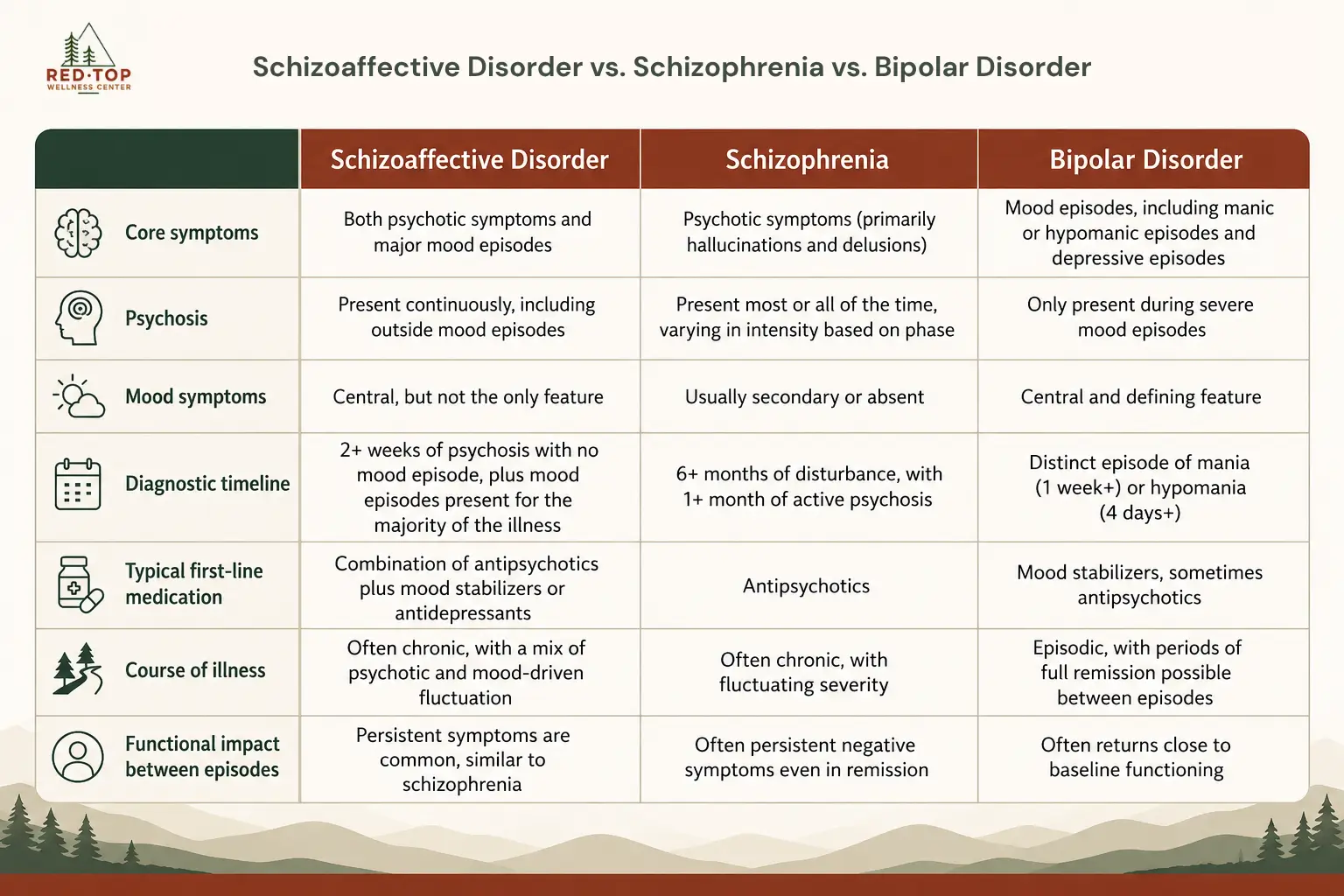
Core Symptoms
Overlapping symptoms are the main reason that schizoaffective disorder, schizophrenia, and bipolar disorder get confused. For example, during a manic episode, disorganized speech and behavior can resemble the disorganization seen in schizophrenia. Withdrawal and low motivation, which are negative symptoms in schizophrenia, can look like bipolar depression from the outside.
Here’s how these conditions may look alike:
- Psychosis shows up in all three. Hallucinations and delusions are hallmark features of schizophrenia and schizoaffective disorder, and they can also appear during a severe bipolar manic or depressive episode. A person in the grip of psychotic mania might believe they have a special mission or unique powers. This delusion can look identical to one seen in schizophrenia, even though the underlying condition is different.
- Mood instability shows up in schizophrenia too. Schizophrenia can present depression, and agitation or irritability, which may look similar to hypomania to an untrained observer. On the other hand, the public’s understanding of schizophrenia has been largely shaped by misleading media myths, so these legitimate symptoms are often disregarded as something else.
- Sleep disruption, cognitive difficulty, and impaired insight are common threads in all three diagnoses. This plays a big role in the fact that family members often describe early symptoms in nearly identical terms regardless of which condition eventually gets diagnosed.
Because the symptom picture can look so similar in the early stages, clinicians rely heavily on the pattern over time to arrive at an accurate diagnosis. Specifically, they may observe whether psychosis ever occurs independent of a mood episode, and how long each type of symptom has been present.
Diagnosis
When diagnosing schizoaffective disorder, schizophrenia, or bipolar disorder, clinicians typically rely on a combination of factors. These could include clinical interviews, symptom timelines, collateral history from family members, and, often, weeks or months of observation before landing on a diagnosis with confidence.
Before any of the three diagnoses can be confirmed, clinicians first need to rule out other explanations for the symptoms, including substance use, medication side effects, or sleep deprivation, all of which can produce psychosis or mood symptoms that mimic these disorders.
From there, diagnosis comes down to matching the specific pattern, timing, and duration of symptoms to DSM-5-TR criteria:
- Schizoaffective disorder requires at least two weeks of psychotic symptoms (delusions or hallucinations) occurring with no mood episode present, in addition to major mood episodes (depressive or manic) that are present for the majority of the illness’s total duration. That two-week window of psychosis without a mood component is what separates this diagnosis from bipolar disorder with psychotic features.
- Schizophrenia requires at least six months of disturbance overall, including at least one month of active-phase symptoms such as hallucinations, delusions, disorganized speech, or negative symptoms. The six-month window can include the prodromal and residual phases, not just the active psychotic episode itself.
- Bipolar disorder requires a distinct episode of mania lasting at least one week (or any duration if hospitalization is required) for a Bipolar I diagnosis, or a hypomanic episode lasting at least four days alongside a major depressive episode for a Bipolar II diagnosis. Psychotic features, if present, only occur during these mood episodes.
Because early symptoms so often overlap, an initial diagnosis made during a first hospitalization or crisis is sometimes revised later. This is normal, and it’s part of why ongoing clinical observation in residential care is so important to getting the treatment right.
Course and Prognosis
The long-term trajectory of these three conditions differs in the following ways:
- Bipolar disorder tends to be episodic. Many people return close to their previous level of functioning between mood episodes. With consistent treatment, long stretches of stability are achievable. The main long-term risk is relapse into a new mood episode, often triggered by disrupted sleep, major stress, substance use, or stopping medication.
- Schizophrenia tends to follow a more chronic course. While the intensity of active-phase symptoms often decreases with treatment, negative symptoms frequently persist even during periods of relative stability. Early, sustained treatment is strongly associated with better long-term outcomes, which is part of why timely, accurate diagnosis is so important.
- Schizoaffective disorder often shares schizophrenia’s more chronic course, but with the added complexity of mood-episode relapses layered on top of psychotic symptoms. This combination tends to make the condition harder to fully stabilize and is associated with more frequent adjustments to the treatment plan over time.
Across all three, a treatment team tracks different markers to monitor progress. For bipolar disorder, that typically means mood charting, or tracking sleep, energy, and emotional state to catch early signs of an emerging episode. For schizophrenia, a clinician may measure symptom severity across hallucinations, delusions, and negative symptoms. Diagnosing schizoaffective disorder requires tracking both simultaneously, since either a mood shift or a psychotic symptom can signal an oncoming relapse.
How Treatment Differs for Schizoaffective vs. Schizophrenia vs. Bipolar Disorder
An accurate diagnosis is the foundation upon which the entire treatment plan is built. Getting it wrong can mean months of a person taking medication that doesn’t address their actual illness, or missing a mood stabilizer that would have prevented a crisis.
Here’s how treatment differs across schizoaffective disorder, schizophrenia, and bipolar disorder:
- Medication targets
- Schizophrenia medication typically centers around antipsychotics, because they target the dopamine dysregulation driving hallucinations and delusions.
- Bipolar disorder is treated first with mood stabilizers (like lithium or certain anticonvulsants), sometimes paired with an antipsychotic during acute mood episodes.
- Schizoaffective disorder typically requires both categories working together, since the condition has both a psychotic and a mood component that need to be managed simultaneously.
- Therapy approaches
- Schizophrenia treatment often emphasizes cognitive and social skills training, psychoeducation, and support for negative symptoms.
- Bipolar disorder treatment leans on mood tracking, sleep and routine regulation, and relapse-prevention planning tied to early warning signs of mania or depression.
- Schizoaffective care has to blend both approaches, since a relapse could be triggered by either a mood shift or a psychotic episode.
- Level of care
- Schizophrenia often requires a higher level of care earlier in treatment, since careful symptom monitoring is difficult to manage safely on an outpatient basis alone.
- Bipolar disorder can sometimes be managed on an outpatient basis once mood is stabilized. However, acute manic or depressive episodes, especially with psychotic features or safety risk, typically require a higher level of care to stabilize first.
- Schizoaffective disorder usually needs the highest level of sustained support of the three, since both symptom tracks have to be managed at once and the risk of relapse from either direction is higher.
What Residential Care Looks Like for Schizoaffective vs. Schizophrenia vs. Bipolar Disorder
For all three of these conditions, the period right around diagnosis is exactly when residential treatment offers the most value. An inpatient facility provides numerous benefits to recovery from these three conditions, including:
- 24/7 clinical observation, which allows for faster, safer medication adjustments than outpatient care alone
- A structured daily routine, which is protective for both psychotic and mood-driven symptoms
- Distance from triggering environments, giving the nervous system and the treatment plan room to work
- Integrated therapy, combining individual, group, and family sessions around a single coordinated plan
- A bridge to long-term care, since residential treatment typically ends with a clear discharge plan connecting you to outpatient psychiatry, therapy, and community support
Residential Care at Red Top Wellness Center
Wherever you land on this comparison of schizoaffective disorder vs. schizophrenia vs. bipolar disorder, Red Top Wellness Center is built to meet you there. Our residential facility in Cartersville, Georgia, offers 24/7 clinical and medical support in a comfortable environment designed for genuine stabilization.
Because these three diagnoses require different treatment strategies, even when the symptoms look similar on the surface, each treatment plan at Red Top Wellness Center is built around the individual’s specific presentation. Here’s what our program brings to the table for each of these conditions:
Inpatient Schizophrenia Treatment
Stabilizing schizophrenia usually requires time in a structured, low-stimulation environment where a clinical team can observe symptoms around the clock, dose antipsychotic medication carefully, and watch for side effects. Our inpatient schizophrenia treatment program provides all of this and more, including:
- Space to relearn daily structure without the pressures of work, school, or an unsupportive home environment
- Individualized treatment planning, built around your specific phase and symptom patterns
- Evidence-based therapies, including Cognitive Behavioral Therapy (CBT), Dialectical Behavioral Therapy (DBT), and Acceptance & Commitment Therapy (ACT)
Residential Treatment for Bipolar Disorder
Mood stabilization takes consistency, and a residential setting provides that through daily schedules and routines. Our residential treatment for bipolar disorder is centered around:
- 24/7 support from a clinical team that’s on the lookout for early signs of an emerging manic or depressive episode before it becomes a crisis
- Removal from the daily stressors and unpredictable environment that could otherwise trigger a mood episode mid-treatment
- A full continuum of support, from admissions through discharge planning, so you leave with a clear plan for continued psychiatric care,
Residential Treatment for Schizoaffective Disorder
Because schizoaffective disorder involves both mood and psychotic symptoms, it’s often the hardest of the three to stabilize on an outpatient basis alone. We provide residential treatment for schizoaffective disorder to ensure that:
- Complex medication regimens are monitored and adjusted precisely as needed over time
- Our clinical team can help you manage both symptoms tracks at once
- You receive layered therapeutic support, combining individual, group, and family therapy to support real stability
Get the Right Diagnosis and Care Today
Schizophrenia, bipolar disorder, and schizoaffective disorder can look strikingly similar on the surface, but in reality, they’re distinct conditions that respond to different treatment strategies. The overlap in symptoms is exactly why an accurate diagnosis matters so much, and why that diagnosis is best treated in a residential setting.
If you’re trying to make sense of a new diagnosis or looking for a program that treats schizoaffective disorder, schizophrenia, and bipolar disorder with the specificity each one requires, our admissions team is happy to help.