Psychotherapy, often called talk therapy, is a form of treatment for mental health conditions that involves working with a trained clinician to understand what you’re experiencing and build skills to manage it. For most mental health conditions, psychotherapy does the central work of treatment, and research has long recognized it as an effective approach for producing lasting improvements in mental health.
Two of the most widely used forms of psychotherapy are cognitive behavioral therapy (CBT) and dialectical behavioral therapy (DBT). They share a foundation, since DBT grew out of CBT, but they target different problems and teach different skills. Knowing which one fits your situation makes it easier to ask the right questions when you start looking for treatment.
This guide explains what CBT and DBT each involve, five differences between them, and how each approach may be beneficial for your own treatment journey.
CBT vs. DBT, Definitionally
What is CBT?
Cognitive behavioral therapy (CBT) is a hands-on form of talk therapy that focuses on the connection between thoughts, feelings, and behaviors. It’s particularly useful for identifying and reshaping negative thought patterns, which helps individuals prevent emotional distress before it sets in.
CBT uses several tools to help you evaluate and develop healthier thoughts, including:
- Journaling
- Thought charts
- Exposure therapy
CBT can be a short- or medium-term intervention, depending on the severity of your mental health challenges and the progress you make throughout treatment. You also may have “homework” to practice the lessons you’ve learned through CBT sessions on your own.
What is DBT?
Dialectical behavioral therapy (DBT) is actually a modified type of CBT that combines self-evaluating techniques with mindfulness practices. The focus of DBT is on daily functioning, helping you learn to manage emotions, navigate relationships, and avoid self-destructive behaviors.
The core skills taught in DBT include:
- Mindfulness to help you focus on the moment.
- Distress tolerance to cope with a crisis without unhealthy behaviors.
- Emotion regulation to understand and manage your feelings.
- Interpersonal effectiveness to improve communication.
Because DBT requires you to apply lessons to real life situations, it’s often considered a longer-term treatment intervention. However, it’s often an important area of focus for treating mental health conditions that significantly impact your ability to get along with others or foster healthy relationships.
What Do CBT and DBT Treat?
CBT and DBT are both used to treat a range of conditions. CBT is more versatile, serving as a broad framework that’s been applied across dozens of diagnoses. DBT was originally developed to treat borderline personality disorder (BPD), but has also proven beneficial for other mental health conditions.
What CBT Treats
CBT is the most widely studied form of psychotherapy, and its research base covers more conditions than any other single approach. The evidence is especially strong behind CBT as a treatment for:
- Depression: CBT is the most examined psychological treatment for depression and is recommended in most treatment guidelines. Research shows that CBT is an effective treatment strategy for depression and leads to lower relapse rates.
- Anxiety: CBT is one of the most efficacious treatments for anxiety, according to a study, because anxiety is commonly fueled by a person’s negative perception of the circumstances surrounding them.
- Substance use disorders (SUDs): As both a standalone treatment and a complement to other treatment types, CBT has been proven effective to treat SUDs.
What DBT Treats
DBT is a more recent form of psychotherapy, meaning its applications are slightly more narrow than those of CBT. However, research is increasingly exploring the usefulness of DBT for treating:
- Borderline personality disorder (BPD): DBT was originally developed by Marsha Linehan to treat BPD and remains the gold standard treatment for the condition.
- Suicidal behavior and self-harm: Studies show that DBT is a leading treatment for individuals experiencing suicidal ideations and self-harming behaviors, effectively reducing these behaviors in some clinical trials.
- PTSD: Due in part to its focus on emotional regulation, DBT has been studied for its effectiveness in mitigating risk behaviors as a result of trauma-related conditions, especially when paired with exposure therapy.
Where CBT and DBT Overlap
Although there are notable differences between CBT and DBT as treatment methods, there is some overlap in their results. Depression, anxiety, PTSD, substance use, and eating disorders all appear in the research literature for both approaches. In practice, the question is usually less about which condition you have and more about which mechanism is driving your symptoms.
When distorted thinking is the engine, CBT targets it directly. When the difficulty is regulating emotion intensely enough that it disrupts your relationships and behavior, DBT’s skills training addresses that more precisely.
Generally speaking, a combination of both therapies can be helpful for addressing these mental health conditions. This is especially true in dual diagnosis treatment, where a comprehensive treatment approach can address multiple conditions occurring at the same time.
CBT vs. DBT: 5 Main Differences
DBT grew out of CBT, so the two share vocabulary and a fair amount of structure. The main differences between the two may show up in what a session asks of you, how long treatment runs, and what your therapist is working toward.
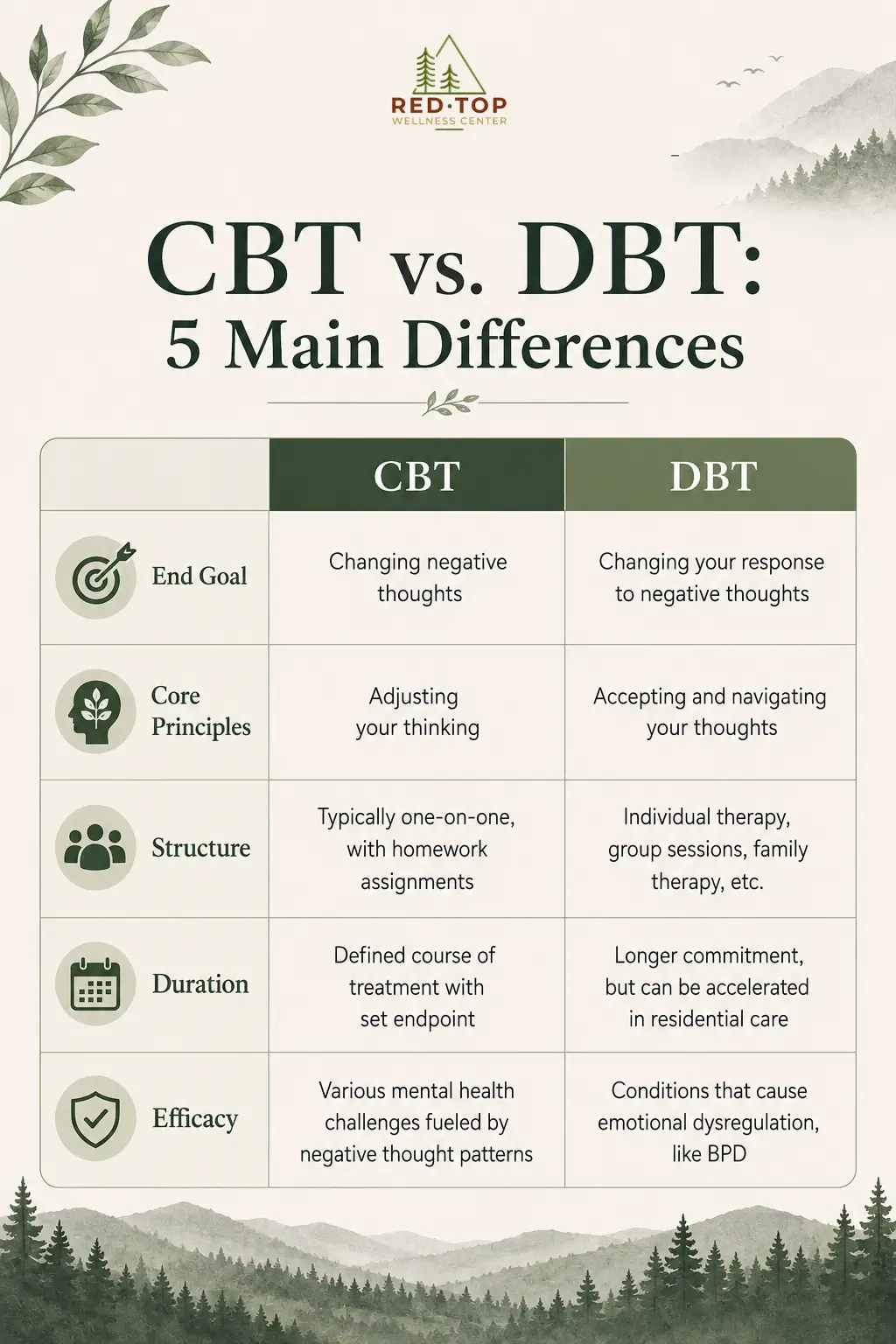
1. End Goal
CBT was designed as a general framework. It rests on the idea that thoughts, feelings, and behaviors influence each other, and that changing one changes the others.
DBT, on the other hand, is centered around teaching practical skills for managing stress and difficult emotions. Rather than changing the thoughts or emotions themselves, DBT focuses on changing someone’s response to those difficult feelings.
In short, CBT and DBT have different end goals. CBT is targeted toward redirecting your own thought patterns, while DBT is adapted to address your outward behaviors based on those thought patterns.
2. Core Principles
CBT asks you to identify a thought, examine the evidence for it, and decide whether a different interpretation is more accurate. DBT is two-fold, which is what “dialectical” refers to. It asks you to accept your current emotional experience while also working to change the behaviors driven by that emotional experience.
In other words, the core principles behind these two treatment approaches differ:
- CBT is grounded in your own thinking. You and your therapist look at the specific thoughts that show up before your symptoms worsen, then examine whether those thoughts could be changed.
- DBT is centered around acceptance. Rather than examining one thought at a time, DBT teaches you a set of tools and allows you to practice applying them. The “tools” are the four pillars of this treatment method: mindfulness, interpersonal effectiveness, emotion regulation, and distress tolerance.
The practical difference: CBT homework usually means noticing and recording your thoughts. DBT homework usually means using a specific skill and tracking what happened.
3. Structure
Standard CBT runs on individual sessions, sometimes with a group component added.
In contrast, DBT combines multiple treatment formats, including individual sessions, group skills training, and family therapy. This variation is central to DBT’s primary goal: focusing on your outward behaviors and interpersonal skills.
4. Duration
CBT is typically delivered as a defined course of treatment with a set endpoint, and the length depends on the condition and severity.
DBT was designed as a longer commitment, largely because the skills curriculum takes time to teach and repeat. However, this timeframe can be accelerated in an inpatient mental health facility, where you’re living in the treatment environment full-time. These programs immerse you in individual sessions and group work daily, so you can cover material faster than a weekly outpatient schedule allows.
5. Efficacy
Ask what’s driving your symptoms rather than which therapy performs better overall.
CBT tends to fit when a thought pattern is doing the damage:
- You make catastrophic predictions about what will go wrong
- You assess yourself far more harshly than the evidence warrants
- You hold beliefs about danger that don’t match your actual circumstances
- Your anxiety runs on specific predictions, which CBT gives you a way to test. This is the foundation under most coping skills for anxiety.
DBT tends to fit when the intensity of the emotion is the problem:
- Emotions arrive fast and large, with little warning
- Those emotions disrupt your relationships
- They lead to self-harm or impulsive behavior you regret afterward
Plenty of conditions call for both. Take PTSD, for example. Most people associate PTSD with its common warning signs, such as flashbacks and nightmares. In this case, you might expect treatment to help minimize those traumatic memories or soothe your symptoms when they occur.
In reality, CBT and DBT can work together to address PTSD at its root. Trauma-focused CBT addresses the beliefs trauma installs, while DBT skills help you tolerate the physical intensity that comes with them.
How to Know Which Approach is Right for You
At Red Top Wellness Center, both CBT and DBT are part of the residential program, and you don’t need to choose between them before you call. Your primary therapist decides how to combine them based on your initial assessment.
Deciding between CBT and DBT depends on your needs. If your therapist wants you to focus on practical tools for specific issues, CBT could be the first step. If your treatment should focus on strengthening relationships and building interpersonal skills, DBT might be your best fit.
At Red Top Wellness Center, we understand that therapy isn’t one-size-fits-all. Call (470) 227-7574 today to learn how we incorporate CBT and DBT into comprehensive care plans that are both clinically-grounded and personalized to meet your exact needs.