If you’ve spent any time researching holistic treatment options for anxiety, you’ve probably come across red light therapy. Once known mainly for skin health and muscle recovery, red and near-infrared light is now being studied for its potential effects on mood, stress, and the nervous system.
As these studies are increasingly talked about in the mental health community, many people seeking treatment are left asking, “does red light therapy help anxiety?” And the truth is, it can. This guide breaks down the benefits of red light therapy for anxiety, and what this therapeutic approach looks like in practice.
What the Research Says About Red Light Therapy for Anxiety
Red light therapy uses specific wavelengths of red (roughly 600–700 nm) and near-infrared (roughly 700–900 nm) light to influence activity inside cells. For anxiety specifically, researchers are most interested in near-infrared light applied to the scalp and forehead. This technique is called transcranial photobiomodulation (t-PBM) and it targets the brain tissue.
The idea is that red light therapy helps anxiety by:
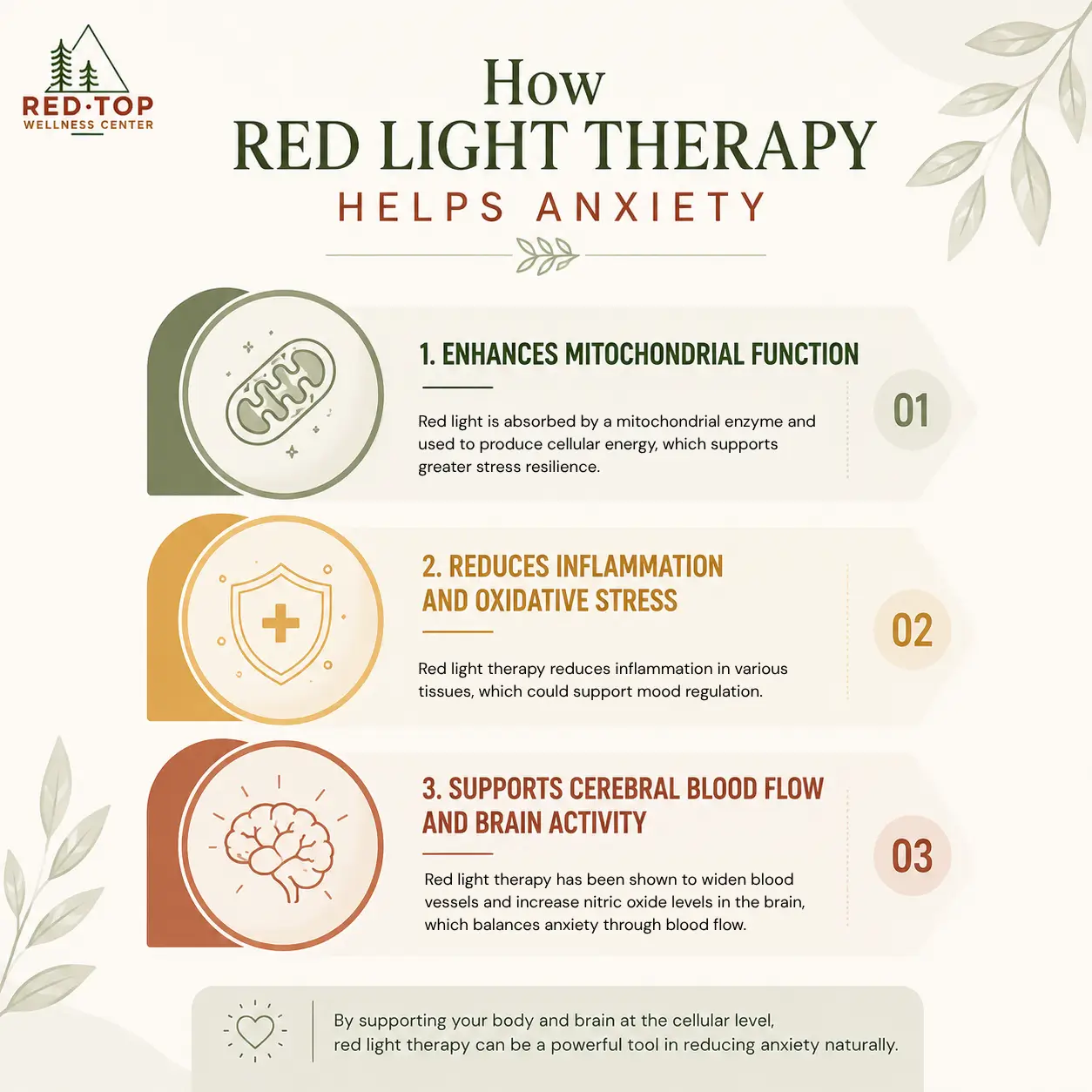
- Enhancing mitochondrial function. Studies show that red and near-infrared light is absorbed by a mitochondrial enzyme called cytochrome c oxidase, which plays a role in producing cellular energy (ATP). Better-functioning mitochondria in brain cells are thought, in theory, to support healthier neuronal activity and stress resilience.
- Reducing inflammation and oxidative stress. Chronic anxiety and stress are associated with low-grade inflammation in the body. Photobiomodulation has anti-inflammatory effects in various tissues, and some researchers hypothesize this could indirectly support mood regulation.
- Supporting cerebral blood flow and brain activity. Research suggests that photobiomodulation can widen blood vessels and increase nitric oxide levels in the brain, leading to enhanced cerebral blood flow. Because stress changes the way blood moves through your brain, enhanced blood flow may yield a better balance that calms anxiety.
To sum it all up: red light therapy supports the brain functions that are connected to decreased anxiety. While it shouldn’t replace traditional therapies, like cognitive behavioral therapy (CBT), that have been proven to mitigate anxiety symptoms, red light therapy serves as a promising complement to traditional approaches.
In fact, several studies have measured the effects of red light therapy for anxiety directly. In an open-label pilot study, researchers tested transcranial photobiomodulation for generalized anxiety disorder (GAD) by having 15 participants with GAD self-administer daily sessions of near-infrared light (830 nm) to the forehead. This experiment lasted eight weeks and, in the end, participants showed reductions in anxiety symptom scores and improved sleep quality.
Bottom line on the evidence: Red light therapy for anxiety is a genuinely promising area of research, anchored by legitimate work out of major academic medical centers. It’s currently best understood as an experimental complementary approach, not a substitute for evidence-based anxiety care such as psychotherapy or medication.
Frequently Asked Questions About Red Light Therapy for Anxiety
Now that you know how red light therapy helps anxiety, you may have more questions about its practical application. We’ve answered some of the most commonly asked questions about red light therapy for anxiety, and other conditions, below.
What safety precautions should be taken when using red light therapy for anxiety?
Red light therapy is generally considered low-risk when used appropriately, but it isn’t automatically risk-free for everyone. Here are some safety considerations to keep in mind before participating in red light therapy:
- Wear eye protection. Direct exposure to high-intensity red or near-infrared light can be uncomfortable or potentially harmful to the eyes. Be sure to wear appropriate eyewear or position your eyes away from the light.
- Know photosensitivity and medications. Certain medications (including some antibiotics, retinoids, and other photosensitizing drugs) and certain skin or medical conditions can increase sensitivity to light-based treatments. Be transparent about your health history and any medications you’re taking with the professional administering your treatment.
- Consider device quality and administration. Not all consumer red light devices are created equal, and unsupervised use at spas or with unregulated devices carries more uncertainty than supervised use with medical-grade equipment. Some FDA-cleared devices exist for specific indications, but clearance for one use doesn’t automatically mean a device is validated for anxiety treatment.
- Don’t use red light therapy as a substitute for diagnosis or treatment. Anxiety disorders vary widely, and what helps one person may not help another. A licensed clinician should be involved in decisions about how (or whether) red light therapy fits into your care.
Can red light therapy help with co-occurring conditions?
Scientific research doesn’t stop at red light therapy for anxiety. Photobiomodulation can support other mental health conditions, making it an effective complement to many treatment plans.
Some care plans incorporate red light therapy for obsessive-compulsive disorder (OCD), because of its anti-inflammatory effects. Research has also backed the efficacy of red light therapy for depression, showing that the reduction in oxidative stress can help mitigate depressive symptoms.
How long does it take for red light therapy to make a difference in anxiety symptoms?
The ideal duration of red light therapy is decided on a case-by-case basis, because its potential effectiveness depends heavily on several factors (primarily, the patient’s symptoms and health history). In many research studies, participants use near-infrared light daily or weekly for two or more months before researchers measure outcomes.
Also, there’s no established minimum of red light therapy for anxiety, since dosing hasn’t been standardized in any industry-wide regulations. Ultimately, you’ll need to talk with a qualified mental health professional to understand the course of treatment and set your expectations accordingly.
Can I just buy a red light panel and use it at home for anxiety?
You can, but keep expectations realistic. Home devices vary enormously in wavelength accuracy, intensity, and quality control, and there’s no consumer-grade protocol proven specifically for anxiety. If you have an anxiety disorder, it’s worth discussing any home use with a treating clinician, especially if you’re on medications that increase light sensitivity.
Is red light therapy the same as bright light therapy?
No. Bright light therapy refers to full-spectrum white light at higher lux levels, and it has a stronger, longer-established evidence base for treating seasonal affective disorder (SAD). Red and near-infrared light therapy works through different proposed mechanisms and has a separate, smaller body of research behind it.
How Red Top Wellness Center Uses Red Light Therapy for Anxiety Treatment
At Red Top Wellness Center, we believe in a holistic treatment approach for all mental health conditions, including anxiety. That means going beyond traditional talk therapies by incorporating alternative techniques that support healing the whole person: their body, mind, and spirit.
We’re proud to offer inpatient anxiety treatment that incorporates red light therapy as just one component of our holistic approach. We consider red light therapy for anxiety as a supportive tool within a comprehensive program. In practice, that looks like:
- A supplement to core treatment rather than a replacement. When you receive red light therapy at our facility, you’re also engaged in the clinical work that has the strongest evidence base for anxiety. This could include individual and group therapy, medication management where appropriate, and skills-based approaches like dialectical-behavioral techniques.
- An individualized experience. We always personalize our care plans, because we believe mental health treatment is only effective when it’s completely tailored to you. We extend that mindset to red light therapy, too. Contraindications, medications, and your unique treatment goals are reviewed before red light therapy is included in your care plan.
- A relaxing routine. For many, red light therapy is one of the most calming activities they engage in during residential treatment. It often serves as a quiet, low-stimulation period that can support the broader goal of nervous-system regulation, alongside other practices, like our biosound therapy sessions.
- Supervision from trained clinical staff. Rather than leaving it as a self-directed or unsupervised amenity, our team members administer red light therapy so you can fully relax and enjoy the treatment. Session length, frequency, and device type are chosen based on your exact needs and medical history.
Most importantly, our residential facility in Cartersville, Georgia, allows you to step away from daily stressors that may be contributing to your anxiety. That means that red light therapy, and any other treatment modalities used in your care plan, aren’t stalled by any external factors that could hinder your progress. As we track your recovery progress within your broader treatment plan, we aim to evaluate red light therapy’s contribution alongside all the other activities you’re engaging in.
Ask How Your Care Plan Can Incorporate Red Light Therapy for Anxiety
Red light therapy is one of the more interesting emerging tools in the anxiety treatment conversation. If you’re interested in learning how this approach can support your experience with an anxiety disorder, the best thing you can do is call our team.
Talking to someone about your exact experiences is the first step toward developing an actionable plan for your treatment. Our admissions team is happy to help you decide if residential care should be part of that plan, and we’re here to answer your questions about how red light therapy fits into it.
If you’re navigating an anxiety disorder, reach out to our team to learn more about the admissions process, what your insurance covers, and how you can take the first step toward healing.